2026
The Weave of Memory and the Inner Cage
- Medium
- Mixed-media sculpture & spatial installation — reclaimed textiles, wire armatures, canvas backdrop
- Role
- Concept design, structural wire armature engineering, textile reclamation & binding, spatial installation
- Tools
- 8mm mild steel core rod, Annealed 14-gauge GI wire, Pliable aluminum craft wire, Post-consumer reclaimed textiles, Vintage saris and denim strips, Coarse jute burlap sacking, Multi-colored wool yarn, Black velvet and gabardine, Stretched canvas backdrop, Reinforced display plinth
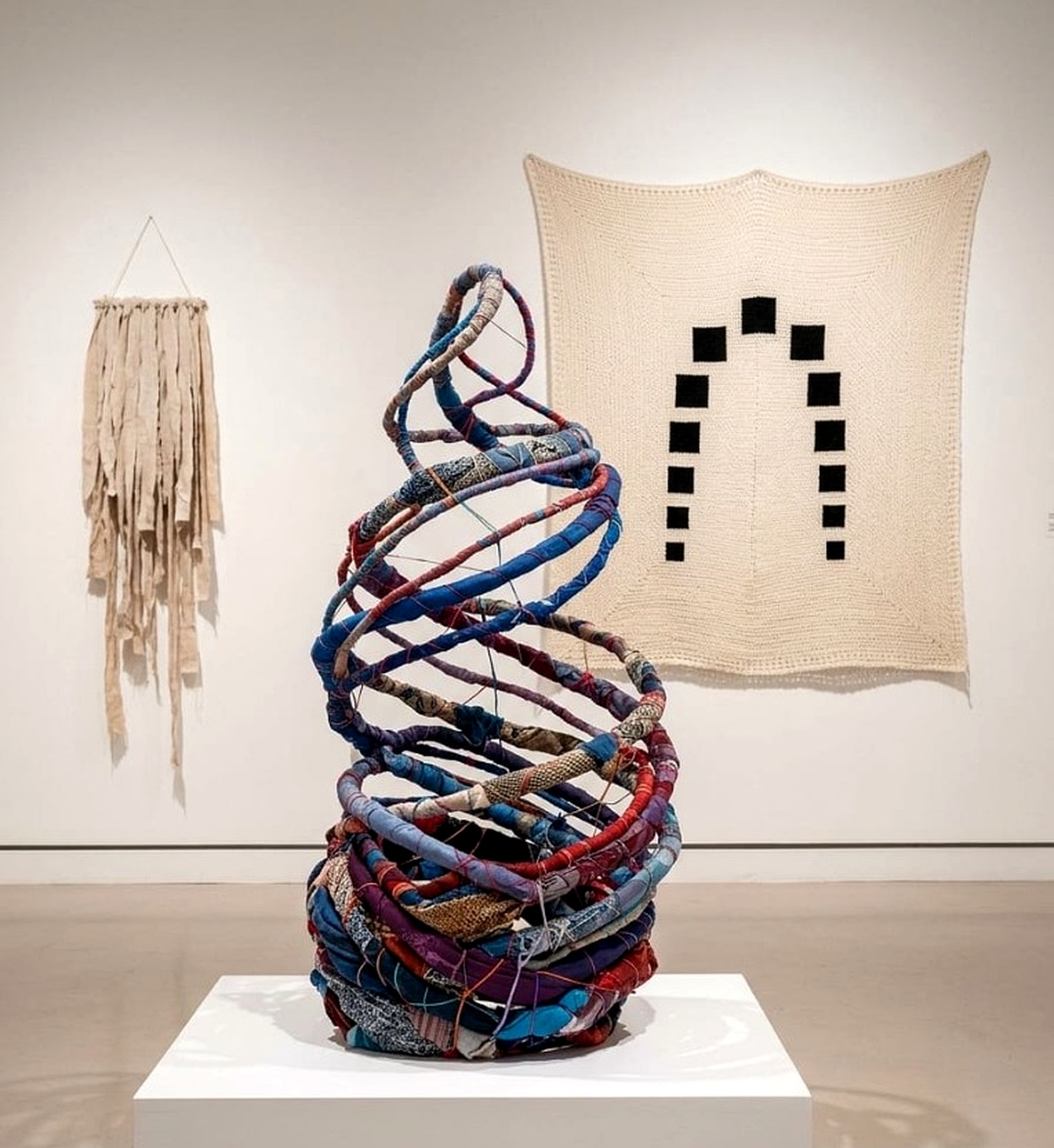
The Weave of Memory and the Inner Cage — 3D studio concept study & spatial installation layout, 2026
The Weave of Memory and the Inner Cage (স্মৃতির বুনন ও অন্তরের খাঁচা) investigates the human subconscious mind, personal and shared recollection, and the instinctive architectures of emotional self-preservation. Anchored by an ascending five-foot helical spiral hand-wrapped in discarded post-consumer textiles, the sculpture transforms discarded garments—impregnated with unvoiced human histories—into an embodied spatial monument. The vibrant, tightly bound exterior operates as a protective cage shielding a vulnerable, cavernous interior void, entering into dynamic dialogue with a suspended geometric wall hanging titled The Arch of Transitions (রূপান্তরের তোরণ).
01
The Spiraling Form & Memory Archive
The primary sculpture ascends from the gallery plinth in an organic, expanding spiral, physically embodying the concept that memory does not move in a straight chronological line. Rather, psychic life recurs, twists, loops upon itself, and accumulates weight through lived experience.
The helical skeleton acts as an open, three-dimensional physical archive. As the viewer circles the plinth, the shifting perspectives reveal overlapping strata of color, density, and negative space, reflecting the fluid, non-linear architecture of human recollection.
02
Textile Wounds, Tensile Binding & Healing
Every scrap of fabric incorporated into the sculpture was reclaimed from post-consumer domestic sources across Dhaka—worn denim, printed cottons, frayed jute sacking, and vintage silk saris. Each remnant carries the intimate, somatic imprint of human touch, sweat, and emotion.
The physical action of tightly twisting, stretching, and knotting these rags across the metal armature represents the painful friction, psychological wounds, and strain endured throughout life. Simultaneously, the communal act of binding these discarded fragments into a resolute, unified structure serves as a tangible monument to human resilience, endurance, and psychic healing.
03
Negative Space & The Arch of Transitions
Crucial to the sculpture’s poetic resonance is its cavernous interior void. The space within the ascending spiral is left hollow, representing the quiet, vulnerable, and often isolated center of the human spirit. The dense, colorful exterior forms an "inner cage"—a protective fortress that shields this delicate interiority from external trauma.
Directly behind the pedestal, a suspended 4×5 ft woven wall hanging features black velvet and gabardine squares arranged in an ascending parabolic arch. Titled The Arch of Transitions (রূপান্তরের তোরণ), this monochrome portal creates a serene threshold between the chromatic chaos of present reality and the tranquil depths of the subconscious, guiding the viewer toward transcendence.